सप्त (Sapta) = Seven
धातु (Dhatu) = That which supports, sustains, or maintains something
In Ayurveda, सप्तधातु refers to the seven fundamental bodily constituents responsible for maintaining the body’s structure and supporting its functions.
| Dhatu | English Name | Function |
| रस धातु (Rasa Dhatu) | Nutrient fluid | Nourishment and distribution of nutrients |
| रक्त धातु (Rakta Dhatu) | Blood | Life-supporting functions |
| मांस धातु (Mamsa Dhatu) | Muscle tissue | Body structure and covering |
| मेद धातु (Meda Dhatu) | Adipose or fat tissue | Lubrication, nourishment, and bodily support |
| अस्थि धातु (Asthi Dhatu) | Bone tissue | Structural support |
| मज्जा धातु (Majja Dhatu) | Primarily marro | Filling and nourishing functions |
| शुक्र धातु (Shukra Dhatu) | Reproductive tissue | Reproduction |
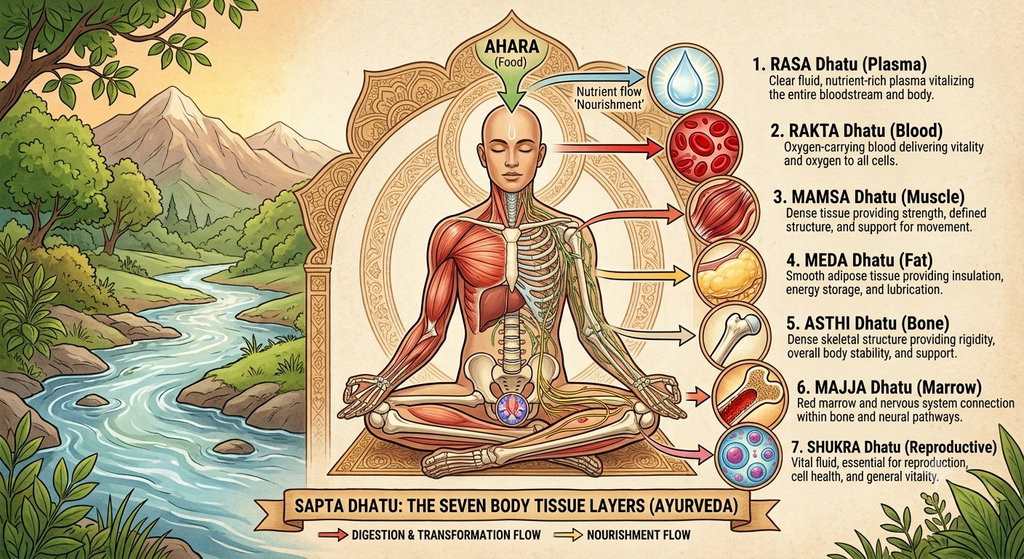
The classical formulation of this sequential synthesis is preserved in the Sushruta Samhita (Sutra Sthana 14.10):
रसाद्रक्तं ततो मांसं मांसान्मेदस्ततोऽस्थि च।
अस्थ्नो मज्जा ततः शुक्रं शुक्राद्गर्भः प्रजायते॥
rasād raktaṁ tato māṁsaṁ māṁsān medas tato’sthi ca |
asthno majjā tataḥ śukraṁ śukrād garbhaḥ prajāyate ||
From nutrient plasma (rasa) arises blood (rakta); from blood, muscle (mamsa); from muscle, fat (meda); from fat, bone (asthi); from bone, marrow (majja); from marrow, reproductive essence (shukra); and from shukra, the embryo is born.
Significance in today’s life-
Consider modern burnout. When someone survives on irregular takeout, chronic stress, and late-night screen time, their initial digestion falters. In modern physiological terms, poor gut absorption (rasa) leads directly to low iron and poor oxygenation (rakta), followed by muscle weakness (mamsa), metabolic dysfunction (meda), brittle bones (asthi), depleted nervous resilience (majja), and reproductive or hormonal imbalances (shukra).
The texts insist that you cannot fix deep nervous exhaustion by merely treating the symptoms—you have to repair the fire that digests your life from the first tissue upward.
रस धातु (Rasa Dhatu)
According to Ayurveda, food undergoes digestion and transformation through the action of जठराग्नि (Jatharagni).
From the processed food, a nourishing portion called आहार रस (Ahara Rasa) becomes available for bodily nourishment. This nourishment supports the formation and maintenance of रस धातु. The simplified conceptual sequence is:
आहार (food) → पाचन (digestion) → आहार रस (processed nourishment) → रस धातु
This is the Ayurvedic explanatory model. It should not be understood as a literal sequence of separate fluids forming one after another in the exact manner described by modern anatomy.
What are the functions of Rasa Dhatu?
Classical Ayurvedic descriptions emphasize functions such as:
प्रीणन (Preenana) — Nourishing and sustaining the body.
तुष्टि (Tushti) — Contributing to satisfaction or a sense of nourishment.
रक्तपुष्टि (Rakta Pushti) — Supporting the nourishment of Rakta Dhatu.
Depending on the context, disturbances associated with Rasa Dhatu may be discussed in relation to weakness, inadequate nourishment, or other bodily symptoms. Consider what happens when you eat a balanced meal- Your digestive system breaks food down. Nutrients are absorbed, transported, and made available to cells throughout the body. Your body uses these nutrients to maintain its tissues, regulate bodily processes, and repair damage.
The body cannot maintain its tissues without a continuing supply of nourishment.
रक्त धातु (Rakta Dhatu)
Rakta Dhatu is associated primarily with blood and its life-supporting functions.
Why is Rakta important?
Ayurvedic descriptions associate Rakta Dhatu with:
जीवन (Jeevana) — Sustaining life.
वर्णप्रसादन (Varna Prasadana) — Supporting healthy complexion.
मांसपुष्टि (Mamsa Pushti) — Supporting the nourishment of Mamsa Dhatu.
Modern medicine describes blood as a specialized connective tissue containing several major components:
Platelets: Components important for blood clotting.
Blood also transports nutrients and hormones, helps regulate temperature and acid-base balance, and contributes to immune defense.
Plasma: The liquid component containing water, proteins, electrolytes, nutrients, hormones, and waste products.
Red blood cells: Cells that transport oxygen through haemoglobin.
White blood cells: Cells involved in immune defence.
This modern description helps us appreciate why blood is essential to the maintenance of the entire body.
मांस धातु (Mamsa Dhatu)
मांस (Mamsa) means flesh or muscle in this context.
What are the functions of Mamsa Dhatu?
लेप (Lepa) — Covering or enveloping bodily structures.
देहपुष्टि (Deha Pushti) — Supporting bodily development and mass.
How does modern physiology explain muscle?
Modern anatomy distinguishes several types of muscle:
| Muscle type | Location or example | Main function |
|---|---|---|
| Skeletal muscle | Quadriceps, hamstrings, glutes, biceps | Movement, posture, and force production |
| Smooth muscle | Walls of the intestines and many blood vessels | Movement of substances and regulation of organ function |
| Cardiac muscle | Heart | Pumping blood |
When people discuss muscle building through exercise, they usually mean skeletal muscle.
Does more muscle always mean better Mamsa Dhatu?
Not necessarily, visible muscle size alone does not tell you everything about muscular health. Strength, endurance, mobility, coordination, recovery, and the ability to perform everyday activities are also important.
मेद धातु (Meda Dhatu)
मेद (Meda) refers to fat or adipose tissue in the Ayurvedic context. Meda Dhatu is associated with bodily fat, lubrication, and the maintenance of bodily tissues.
What are the functions of Meda Dhatu?
Classical descriptions associate Meda Dhatu with:
स्नेहन (Snehana) — Lubrication
दृढ़त्व (Dridhatva) — Firmness or stability.
Why is fat important in modern physiology?
Body fat is not simply unwanted material.
Adipose tissue performs several important functions:
Metabolic regulation: Participates in the regulation of energy balance and insulin sensitivity. The amount and distribution of body fat matter.
Energy storage: Stores energy in the form of triglycerides.
Endocrine function: Releases hormones and signaling molecules involved in appetite, metabolism, and other processes.
Insulation: Helps reduce heat loss.
Protection: Provides cushioning around some structures.
अस्थि धातु (Asthi Dhatu)
अस्थि (Asthi) means bone. Asthi Dhatu refers primarily to the body’s bones and their structural role. Bones provide the framework that supports the body and helps protect important organs.
How does modern science explain bone? Bone is living connective tissue.
It contains:
A mineral component, particularly calcium phosphate in the form of hydroxyapatite.
An organic matrix, largely composed of collagen and other proteins.
Bone cells responsible for formation, maintenance, and resorption.
Three important bone-cell types are:
| Cell type | Main function |
| Osteoblasts | Build new bone |
| Osteoclasts | Resorb or break down bone |
| Osteocytes | Help maintain bone tissue and respond to mechanical signals |
Bones are continuously remodelled. The skeleton is therefore not a fixed, lifeless framework. It adapts to loading, hormonal signals, nutrition, age, and other factors.
Why are bones important beyond support?
Bones have several functions:
Structural support: They help maintain body shape.
Movement: They provide attachment points and levers for muscles.
Protection: The skull protects the brain, while the rib cage protects parts of the heart and lungs.
Mineral storage: Bone stores much of the body’s calcium and phosphorus.
Blood-cell production: Bone marrow contains tissues involved in blood-cell production.
मज्जा धातु (Majja Dhatu)
मज्जा (Majja) is traditionally associated with marrow, particularly the material found within bones.
In classical Ayurvedic descriptions, Majja Dhatu is discussed in relation to filling the bones, unctuousness, strength, and the nourishment of Shukra Dhatu.
Is Majja Dhatu the same as bone marrow?
Bone marrow is an important comparison, but the two concepts are not necessarily identical in scope.
Modern bone marrow contains:
- Hematopoietic stem and progenitor cells.
- Developing red blood cells.
- Developing white blood cells.
- Platelet-producing cell lineages.
- Supporting stromal and other cell populations.
Bone marrow is essential for the production of blood cells. Red bone marrow is especially important in hematopoiesis, while yellow marrow contains a greater proportion of fat.
Is Majja Dhatu the nervous system?
You may encounter explanations that translate Majja Dhatu as both bone marrow and nervous tissue. Some modern Ayurvedic interpretations use the concept broadly when discussing neural structures. However, it is important not to assume that all classical Ayurvedic texts define Majja Dhatu as the entire nervous system.
शुक्र धातु (Shukra Dhatu)
शुक्र (Shukra) can mean bright, clear, or pure in different Sanskrit contexts. In Ayurvedic physiology, Shukra Dhatu is associated with reproductive capacity and reproductive tissue. The traditional concept is broader than simply the fluid released during ejaculation, although semen is a major point of reference in many explanations.
Classical Ayurvedic descriptions associate Shukra Dhatu with:
गर्भोत्पादन (Garbhotpādana) — Reproduction or the production of offspring.
बल (Bala) — Strength.
हर्ष (Harsha) — Pleasure or a sense of well-being.